


Quick answer: Underfloor heating (UFH) delivers superior comfort and runs at lower temperatures — making it a strong match for heat pumps and well-insulated homes. Radiators are cheaper to install, faster to respond, and perfectly capable with the right controls. For most UK homes, a hybrid approach (UFH downstairs, radiators upstairs) hits the sweet spot. Read on for the full picture.
You know the scene. It's January. You've padded to the kitchen in your socks, stepped onto tiles so cold they've stolen your will to live, and immediately started questioning every life decision that led you to this point. Meanwhile, your radiator is doing its best impression of a lukewarm cup of tea — warm enough near the unit, absolutely Arctic anywhere else.
If you're weighing up underfloor heating vs radiators for a new build, renovation, or just because you're thoroughly done with the above, this guide is for you. We install both systems across Essex and the surrounding areas, so we're not here to push one over the other — just to help you make the right call for your home.
Quick answer (if you're in a hurry)
- UFH wins on comfort, heat distribution, aesthetics, and compatibility with heat pumps
- Radiators win on upfront cost, installation speed, and responsiveness
- Hybrid systems (UFH downstairs, radiators upstairs) are increasingly popular — and often the most practical choice
- UFH suits new builds, extensions, open-plan spaces, and tiled floors best
- Radiators remain a perfectly sound choice, especially where disruption needs to be minimal
Not sure which suits your home? Give us a call and we'll talk it through — no obligation, no sales pitch.
What's the real difference between underfloor heating and radiators?
Both systems do the same job — heat your home — but they go about it very differently.
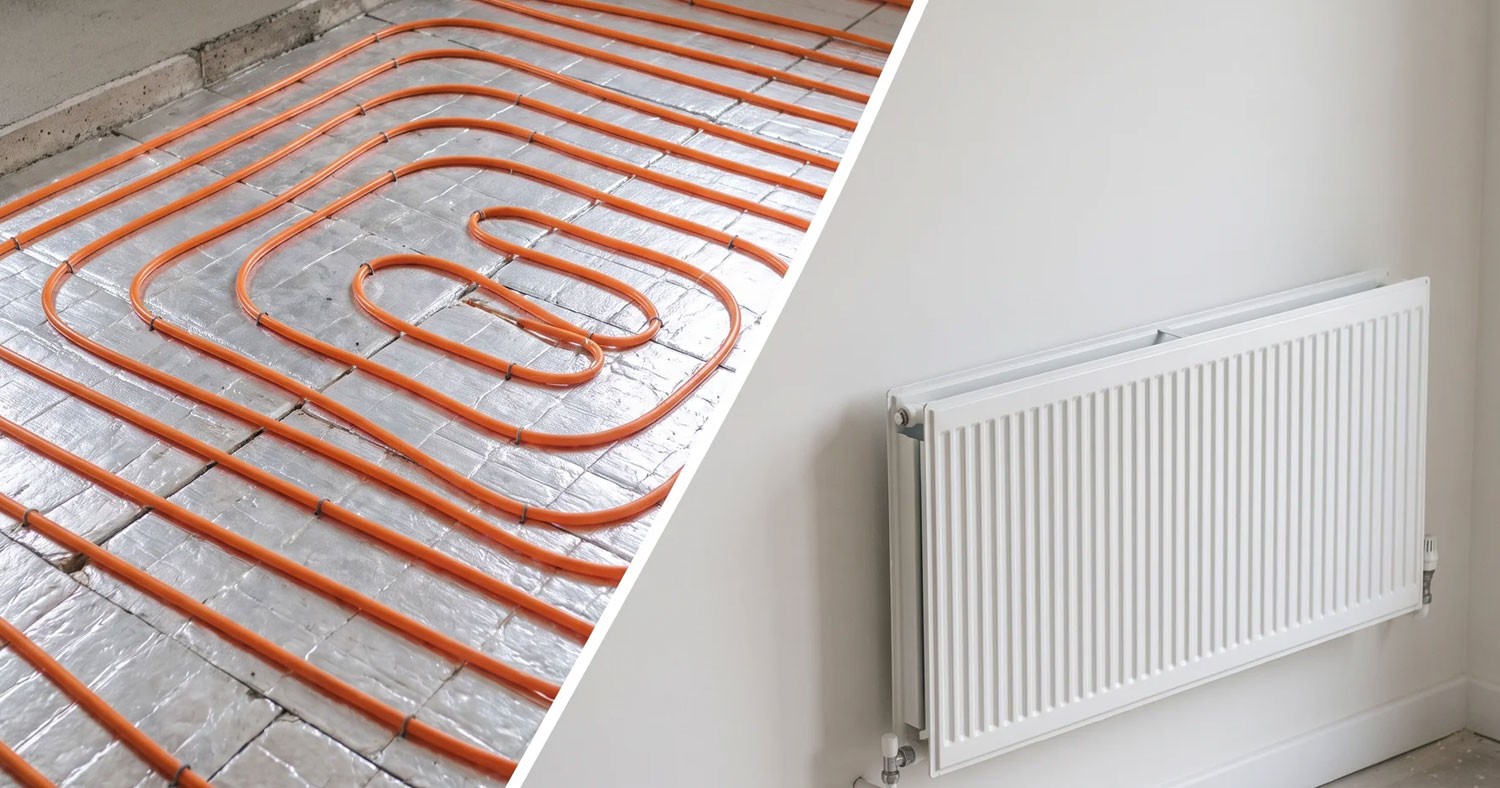
Radiators work mainly through convection. Hot water circulates through the unit, heats the surrounding air, and that warm air rises and circulates around the room. They're quick to heat up, relatively cheap to install, and have been the backbone of UK central heating for decades. They're also, let's be honest, a bit of an eyesore unless you've paid extra for a designer version.
Underfloor heating spreads warmth across a much larger surface area — your entire floor. Water-based (wet) UFH pipes are embedded beneath the floor and heat it gently, radiating warmth upward evenly across the whole room. Because the system uses such a large emitter, it can run at significantly lower water temperatures than radiators — typically around 27–35°C for the floor surface, compared to 65–75°C for a standard radiator circuit.
Electric UFH works on a similar principle but uses heating cables or mats rather than pipework. It's best suited to smaller areas like bathrooms, as running costs are considerably higher than wet systems.
Comparison table
Comfort feel
Underfloor heating: Even, radiant warmth from the floor upwards
Radiators: Warm near the unit, with less even warmth elsewhere
Heat distribution
Underfloor heating: Consistent heat distribution across the whole room
Radiators: Convective heat that can leave cold spots
Typical flow temperature
Underfloor heating: Lower, with the floor typically around 27–35°C
Radiators: Higher, often around 60–75°C
Responsiveness
Underfloor heating: Slower to heat up; better suited to steady, continuous running
Radiators: Faster warm-up
Installation disruption
Underfloor heating: Higher, particularly when retrofitting
Radiators: Lower
New build suitability
Underfloor heating: Excellent
Radiators: Good
Renovation suitability
Underfloor heating: Moderate to complex
Radiators: Easy
Heat pump compatibility
Underfloor heating: Excellent
Radiators: Moderate; may require larger radiators
Maintenance visibility
Underfloor heating: Low, with pipework hidden beneath the floor
Radiators: Easy to access, maintain and bleed
Aesthetics
Underfloor heating: Invisible and frees up wall space
Radiators: Visible, although there are many design options available
Comfort: which feels better day-to-day?
This one isn't particularly close. UFH wins on comfort, and it's not just marketing fluff.
Because heat rises evenly from the floor, you get consistent warmth across the entire room — no cold patches near the window, no sweating beside the radiator. That "toasty toes, comfortable head" feeling is exactly how the human body prefers to be heated, and it's something UFH delivers naturally.
Radiators, by contrast, create convection currents. Warm air rises from the unit and cool air drops — which means rooms can feel uneven, especially in larger or open-plan spaces. They also stir up more dust and allergens, which isn't ideal for allergy sufferers or families with young children.
UFH also frees up your walls entirely. No planning your furniture around radiators. No accidentally burning your sofa by pushing it an inch too close. In bathrooms and kitchens especially, that flexibility is genuinely useful.
That said, towel radiators in bathrooms remain brilliant for warming towels, drying clothes, and general cosiness — and plenty of our customers keep them even when they go for UFH elsewhere in the home.
Efficiency in the UK: the bit everyone really cares about
This is where it gets a bit more nuanced, so bear with us.
UFH efficiency UK figures often cited suggest that wet underfloor heating can be around 15–40% more energy efficient than a traditional radiator system, and roughly 25% more efficient when compared to radiators fed by a gas boiler. The reason? Those lower flow temperatures. The cooler a system runs, the less energy it needs to maintain comfort — and for condensing boilers especially, lower return temperatures improve combustion efficiency too.
But here's the important caveat: this only holds true if the system is designed and installed correctly, and if the property is reasonably well insulated. UFH in a draughty, poorly insulated home will struggle just as much as any other heating system. Getting your insulation and airtightness sorted first makes any heating upgrade work better.
Heat pumps change the calculation significantly. Air source heat pumps are most efficient at lower flow temperatures — ideally below 45°C — which makes UFH a natural partner. The combination is genuinely excellent for both efficiency and running costs. Radiators can work with heat pumps, but often need to be upsized to compensate for the lower flow temperatures, which adds cost and complexity. If heat pump compatibility is on your radar, UFH is the stronger starting point.
We install air source heat pumps across Essex and can advise on the best setup for your property — just ask.
Running costs: what affects the bill (and what doesn't)
We're not going to promise you a specific monthly saving, because honestly, it depends on too many variables: your energy tariff, how you use your thermostat, how well your home retains heat, your zoning setup, and your occupancy patterns.
What we can say:
- UFH tends to perform best when run at a steady, consistent temperature rather than cranking it up and down — its slower response time means it's not ideal for "blast it for an hour" habits
- Radiators with smart TRVs and proper balancing can be very cost-effective, especially in homes with variable room usage
- Zoning — controlling different areas independently — makes a significant difference regardless of system type
- Controls matter more than most people realise. A well-set-up UFH system with poor controls will underperform a well-tuned radiator system every time
Installation and disruption: new build vs renovation realities
Underfloor heating installation considerations
Wet UFH installation involves laying pipework beneath the floor, connecting it to a manifold, and either embedding it in screed or using a dry system with plates. It adds floor height — typically 80–100mm for a screed system — so door thresholds and transitions to adjoining rooms need planning.
In a new build or extension, this is straightforward. In a renovation, lifting existing floors significantly adds to cost and disruption. Installation costs for wet UFH typically run from £95 to £110 per m², with a ground floor installation in an average three-bed home costing roughly £5,000–£7,000.
Electric UFH is easier to retrofit — thin mats sit beneath tiles with minimal floor height increase — but running costs make it best reserved for bathrooms and small spaces.
If you're planning an extension or new build, we can design and install an underfloor heating system tailored to your property — just get in touch to discuss.
Radiator installation considerations
Swapping or adding radiators is generally quicker, cheaper, and far less disruptive. A full property upgrade typically costs between £2,000–£3,000. Pipework alterations for layout changes add time, but it's manageable.
If you're switching to a heat pump, radiators may need upsizing — this is something we can assess as part of any system review.
Responsiveness and control: "I want warm, and I want it now"
Radiators win this one. They heat up quickly, which makes them ideal for rooms that aren't in constant use or for those chaotic mornings when someone's completely forgotten to set the heating timer (no judgement — we've all been there).
UFH takes longer to reach operating temperature — sometimes a couple of hours — which is why it works best when run consistently rather than as a reactive fix. Once it's up to temperature, it maintains warmth beautifully.
Both systems benefit from smart zoning. With UFH, room-by-room thermostats allow excellent control. With radiators, smart TRVs do a similar job. The thermostat arguments in your house are, unfortunately, entirely beyond our remit.
Maintenance and longevity
Neither system is particularly high-maintenance, but here's what to know:
Radiators need occasional bleeding, balancing, and the system should have inhibitor fluid to prevent sludge build-up. Regular boiler servicing is essential — something we offer across Essex.
UFH systems have fewer visible components, but the manifold, pump, and actuators need to be correctly commissioned and periodically checked. If performance drops, it's often down to controls or air in the system rather than the pipework itself.
Both systems benefit from a professional eye every year or so — and we're always happy to help diagnose any performance issues.
Aesthetics and space
UFH is invisible. Full stop. It gives you completely blank walls, more freedom with furniture layout, and a cleaner finish throughout.
Radiators are visible, but design options have come a long way. Column radiators, vertical panels, and towel rails can actually look great — and they double up as a convenient place to warm your towels (a luxury that UFH simply cannot replicate).
Which is best for your home?
Choose UFH if you're:
- Building a new home or extension
- Renovating and happy to deal with floor works
- Pairing with an air source heat pump
- After the best possible comfort in open-plan or tiled areas
- Done with visible radiators cluttering your walls
Choose radiators if you're:
- On a tighter budget
- Renovating without major floor work
- Wanting faster warm-up times
- Working in a property where UFH isn't practical
Go hybrid if you want the best of both:
- UFH on the ground floor (kitchen, living areas, bathrooms)
- Radiators upstairs where comfort vs. cost balance makes more sense
- This is genuinely one of the most popular approaches we install
Common mistakes we see (and how to avoid them)
In our experience, these are the things that catch people out:
- UFH without proper insulation beneath it — you're just heating the ground, not your home
- No heat loss calculation before choosing system size — leads to underperforming setups
- Poor controls on UFH — rooms overheat and energy is wasted
- Radiators not balanced after installation — some rooms roast while others freeze
- Carpet with too high a tog value — carpet and underlay combined should stay below 2.5 tog (under 1.5 if pairing with a heat pump)
- Forgetting door thresholds when adding UFH to existing floors — it sounds minor until you can't close a door
FAQs
Is underfloor heating cheaper to run than radiators in the UK?
It can be, particularly in well-insulated homes and when paired with a heat pump. UFH running at lower temperatures is generally around 15–25% more efficient than traditional radiators fed by a gas boiler, but savings depend heavily on insulation, controls, and usage habits.
Does UFH work with a combi boiler?
Yes, wet UFH is compatible with combi boilers. However, combis aren't always the most efficient pairing since they're designed for higher flow temperatures — a system boiler or heat pump often works better. We can advise on the right boiler setup for your home.
Is UFH better with an air source heat pump?
Significantly, yes. Heat pumps work most efficiently at lower flow temperatures, which UFH is perfectly designed for. The two systems are genuinely complementary, and we install both across Essex and surrounding areas.
Can I mix UFH downstairs and radiators upstairs?
Absolutely — and it's one of the most common setups we design and install. It's a practical, cost-effective way to enjoy UFH comfort on the ground floor while keeping disruption and cost manageable upstairs.
How long does underfloor heating take to warm up?
Wet UFH can take 1–3 hours to reach full operating temperature, depending on floor construction and insulation. This is why it works best when run consistently rather than turned on and off reactively.
Does underfloor heating work with carpet or wood flooring?
Yes to both, with caveats. For carpet, the combined tog value of carpet and underlay shouldn't exceed 2.5 (ideally under 1.5 with a heat pump). Wood floors should be UFH-compatible — engineered wood generally performs better than solid hardwood.
Do radiators need replacing if I switch to a heat pump?
Not always, but sometimes. Heat pumps run at lower flow temperatures than gas boilers, so existing radiators may need upsizing to compensate. We assess this as part of any heat pump installation — there's no need to guess.
What's the best heating for a bathroom — UFH or a towel radiator?
Often both. Electric or wet UFH keeps the floor warm underfoot, while a heated towel rail handles the practical side (warm towels, a bit of extra ambient heat). Many of our bathroom installations include both.
Is electric underfloor heating expensive to run?
Compared to wet UFH, yes — significantly so. Electric systems are best used in small areas like bathrooms where comfort is the priority rather than long-term running cost savings.
How do I know which system is right for my home?
Honestly? Have a chat with someone who installs both. We can assess your property, your heat source, your budget, and your priorities — and give you a straight answer rather than a sales pitch.
Ready to make a decision? We can help
There's no universal winner in the underfloor heating vs radiators debate — the right choice depends on your home, your lifestyle, your heat source, and what you're prepared to spend upfront. What we can tell you is that a well-designed and properly installed system, whichever you choose, makes a genuine difference to comfort, efficiency, and running costs.
We're Gas Safe registered, customer-focused, and based in Essex — with a team that takes real pride in getting installations right first time. Whether you're weighing up UFH for an extension, thinking about a new boiler, or exploring an air source heat pump, we'd be happy to talk it through.
Get in touch today
Finance options may be available subject to status — ask us for details.


