


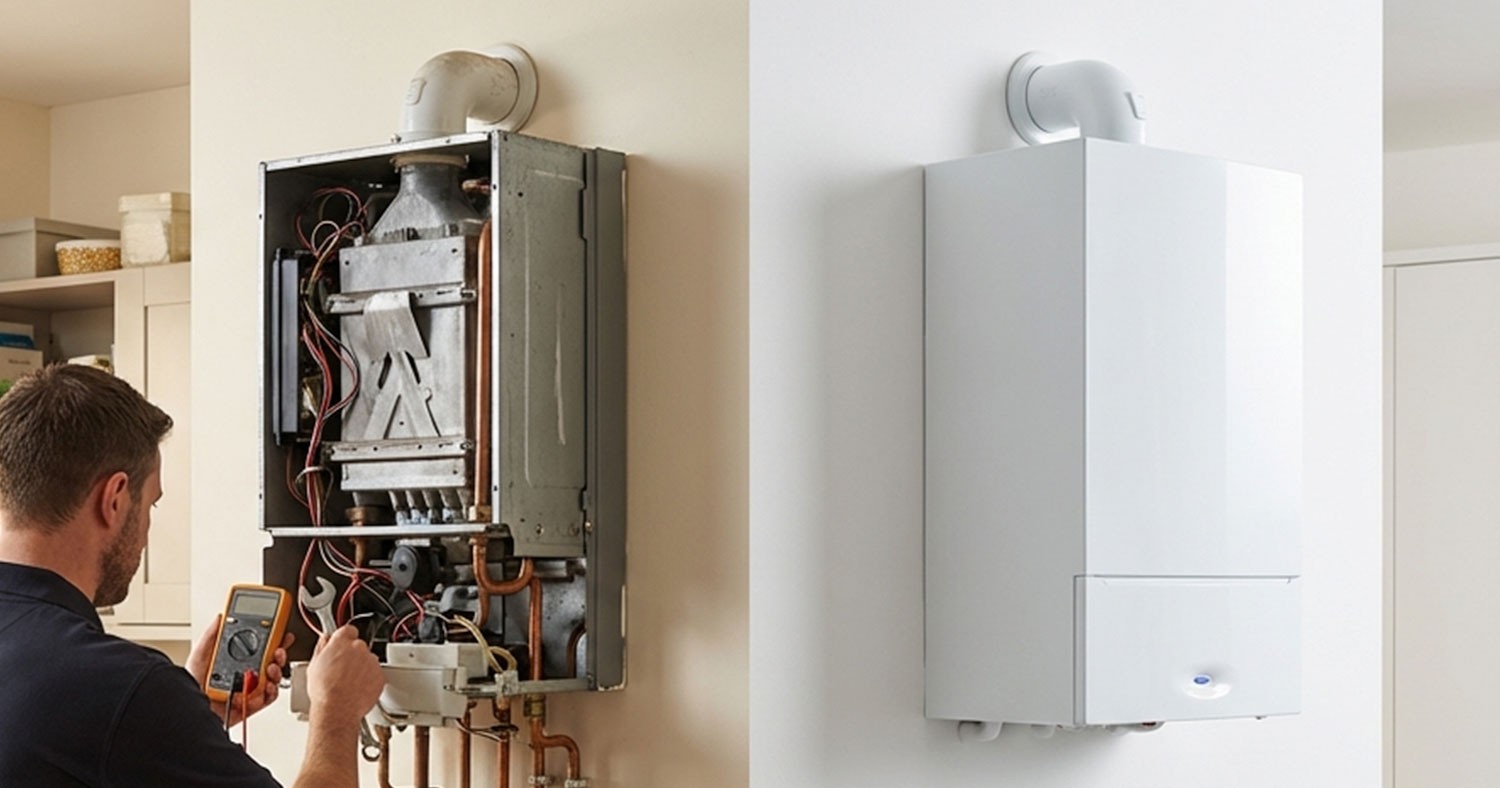
There are few sounds more terrifying to a homeowner than the ominous silence where a boiler’s hum used to be. Usually, this happens on the coldest morning of the year, just as you’re stepping into the shower. It’s the uninvited guest at your bank account’s party, leaving you with a shivering family and a burning question: do I patch this up, or is it time to say goodbye?
At Pilot Light Plumbing & Heating, we’ve seen it all—from simple pressure drops that take five minutes to fix, to ancient relics that belong in a museum rather than an airing cupboard. We know that choosing between boiler repair vs boiler replacement isn't just about heat; it's about balancing your budget, your comfort, and your safety.
Making the wrong call can be costly. Repairing a dying machine is throwing good money after bad, but replacing a boiler that just needed a new valve is a waste of cash. Here is how you can spot the difference and keep your home cosy without breaking the bank.
Signs your boiler needs repair
Before you start browsing catalogues for shiny new heating systems, take a breath. Not every breakdown is a death sentence for your central heating. Modern boilers are robust machines, and often, a minor intervention is all that is required to get things flowing again.
The minor niggles
If your boiler is relatively young (under seven or eight years old) and has generally been reliable, a repair is usually the most sensible route.
- Strange noises: A banging or whistling sound (often called "kettling") usually suggests a build-up of limescale or sludge on the heat exchanger. This isn't terminal; a system flush or a descaler treatment often solves it.
- Low pressure: If your boiler keeps switching off, check the pressure gauge. If it’s below 1 bar, you might just need to top it up via the filling loop. However, if you have to do this constantly, there is likely a leak that a professional needs to find.
- The radiator lottery: If some radiators are hot and others are stone cold, or if they are cold at the top and hot at the bottom, your system likely needs balancing or bleeding. This is a maintenance job, not a replacement job.
When a fix is cost-effective
For boiler repair UK residents often worry about the call-out charges. However, replacing a specific component—like a fan, a printed circuit board (PCB), or a pump—is significantly cheaper than a new installation. If the cost of the repair is less than half the cost of a new boiler, and your current unit is efficient enough, repair is usually the way to go.
Common repair work we handle
At Pilot Light Plumbing & Heating, we frequently tackle issues like:
- Component replacement: Swapping out faulty thermostats or motorised valves for a one off repair.
- Deep cleaning: Removing the sludge that stops water circulating efficiently.
- Addressing leaks: Fixing seals or loose joints before they cause water damage to your property.
Signs your broken boiler needs replacement
Sometimes, you have to be cruel to be kind (to your wallet). There comes a point where keeping an old boiler running is like trying to keep a sinking ship afloat with a bucket. Knowing when to replace boiler units can save you a fortune in emergency call-outs and wasted energy.
Advanced age and no longer energy efficient
Boilers generally have a lifespan of 10 to 15 years. Once a boiler passes its 15th birthday, efficiency drops off a cliff.
Modern condensing boilers are A-rated and must be at least 90% efficient. In contrast, an old G-rated boiler (common in older UK homes) might only be 60% efficient or less. That means for every £1 you spend on gas, 40p is effectively being blown straight out of the flue. Upgrading to a modern system stops this waste immediately.
Frequent breakdowns
Do you have your heating engineer’s number on speed dial? If you are fixing one thing only for another part to fail two months later, your boiler is telling you it’s time to retire. The cost of parts and labour for frequent repairs will quickly eclipse the monthly cost of a finance plan for a brand-new, reliable boiler.
Safety concerns
This is the non-negotiable part. Gas safety is paramount. If you notice any of the following, turn off your appliance and call a Gas Safe registered engineer immediately:
- Yellow flames: A healthy gas flame should be crisp and blue. A lazy yellow flame can indicate incomplete combustion.
- Sooty stains: Dark marks around the appliance casing.
- Physical symptoms: Headaches, nausea, or dizziness when the heating is on could be signs of carbon monoxide poisoning.
If a boiler is deemed "Immediately Dangerous" or "At Risk" by an engineer, and the parts to make it safe are obsolete or prohibitively expensive, replacement is the only safe option.
Factors to consider when deciding
When you are standing in front of your boiler scratching your head, weigh up these three factors.
The cost analysis
Use the "50% Rule." Get a quote for the repair. If that cost is more than 50% of the value of a new boiler (including installation), swap it out. Also, consider the "part availability" factor. If your engineer struggles to source parts because the manufacturer has stopped making them, you are delaying the inevitable.
Environmental impact
We are all trying to be a bit greener. An inefficient boiler burns more fossil fuels to generate the same amount of heat. By switching to a modern, energy-efficient model, you lower your home’s carbon footprint significantly. Plus, new systems are often compatible with smart thermostats, giving you greater control over your energy usage.
Future-proofing
Are you planning renovations? If you are adding an extension or a new bathroom, your old Combi boiler might not have the power (measured in kW) to supply hot water to multiple taps at once. A replacement allows you to size the boiler correctly for your home’s current and future needs.
How the gas engineers at Pilot Light Plumbing & Heating can help
Whether you need a quick fix or a fresh start, Pilot Light Plumbing & Heating is here to keep Essex warm. We don't believe in pushy sales tactics; we believe in giving you the honest advice you need to make the right choice for your home.
When you need to replace your boiler
If a replacement is the best route, we make it painless. We offer boiler installation with a massive 10-year warranty on selected models, giving you a decade of peace of mind.
Worried about the upfront cost? We offer finance options and require no deposit, meaning you can spread the cost while enjoying a warm home immediately. You can get an instant quote directly through our website.
When we can repair your boiler
If there is life in the old dog yet, our Gas Safe registered engineers will find the fault fast. We pride ourselves on a fast and reliable service across Essex and the surrounding regions. We carry common parts in our vans to try and get you up and running in a single visit.
Servicing and Maintenance
Prevention is always cheaper than the cure. Our annual servicing plans ensure your warranty stays valid and helps catch those "minor niggles" before they turn into "major breakdowns."
Frequently Asked Questions
How long should a boiler last?
On average, a decent boiler lasts between 10 and 15 years. Regular servicing can extend this lifespan, while neglect can shorten it. If yours is approaching the 15-year mark, start budgeting for a replacement.
Is it worth repairing a 20-year-old boiler?
Almost certainly not. Even if you fix the immediate issue, parts will be hard to find, and the unit will be incredibly inefficient compared to modern standards. You would save money in the long run by replacing it.
How much does a new boiler cost?
The cost of a new boiler in the UK can vary depending on the boiler type, size, and brand. On average, homeowners can expect to pay between £1,500 and £3,000, including installation. High-efficiency or premium models may cost more but can provide better performance and lower energy bills over time. For the most accurate quote tailored to your needs, get in touch with us today!
Will a new boiler reduce my energy bills?
Yes, a new boiler is likely to reduce your energy bills, especially if your current boiler is older and inefficient. Modern boilers are designed to meet higher efficiency standards, converting more fuel into heat and wasting less energy. Over time, the savings on utility bills can help offset the upfront cost of the new boiler.
According to the Energy Saving Trust, replacing an old G-rated boiler with a modern A-rated condensing boiler can save a semi-detached household hundreds of pounds a year on energy bills.
Can I install a boiler myself?
No. In the UK, it is illegal for anyone other than a Gas Safe engineer to work on gas appliances. DIY gas work puts you, your family, and your neighbours at risk of explosions or carbon monoxide poisoning. Always call a professional.
Making the right call for your home
Deciding whether to repair or replace needn't be a headache. It comes down to safety, efficiency, and long-term cost. If your boiler is a safety hazard or a money pit, let it go. If it’s a modern machine with a minor fault, let us fix it.
Get a free quote today!
Don't let a dodgy boiler dictate your comfort this winter. If you are in Essex or the surrounding area and need honest advice, get in touch with Pilot Light Plumbing & Heating. Whether you need a simple repair or a full installation with a 10-year warranty, we are just a phone call away.


