


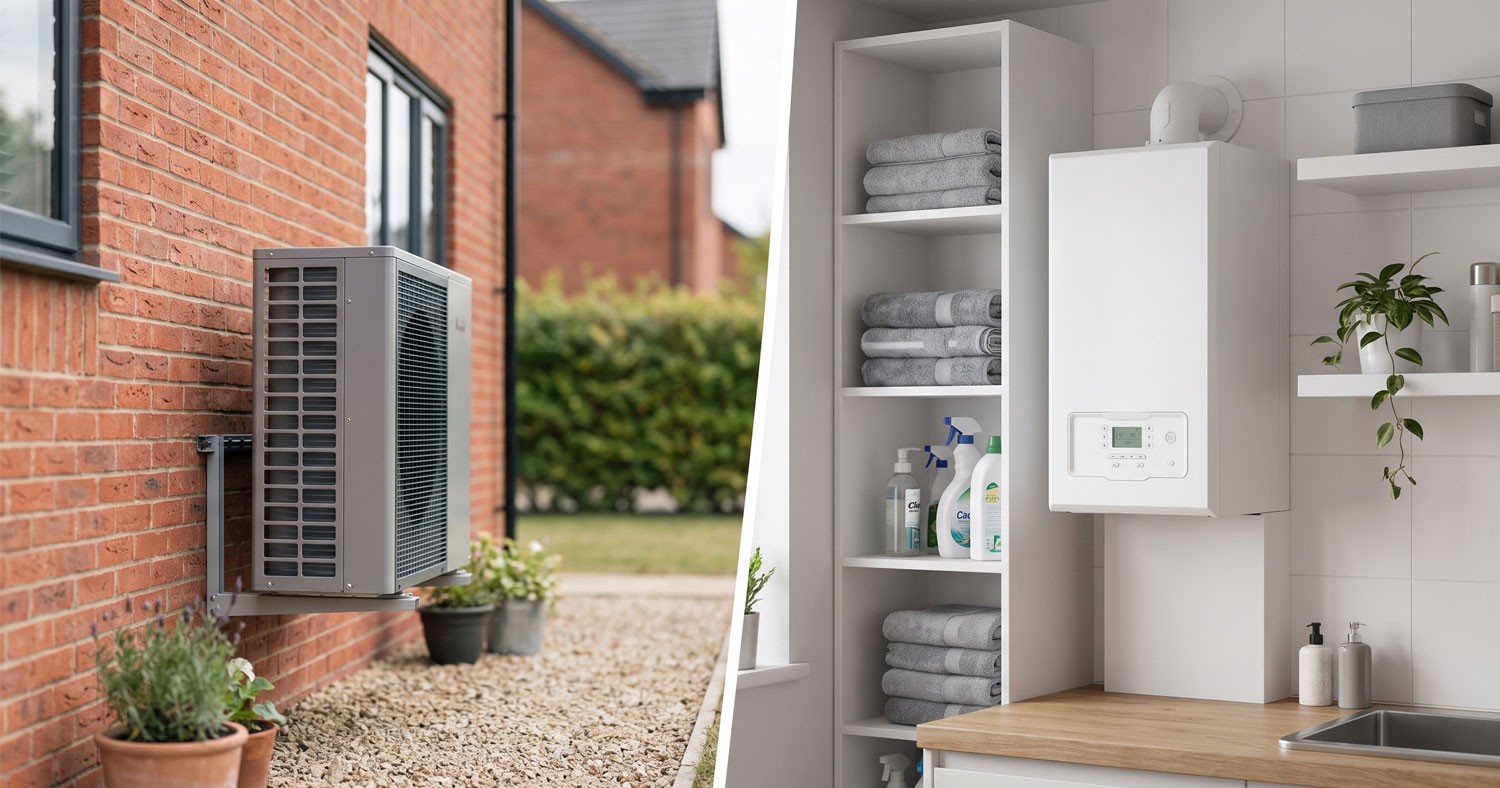
Quick answer: In the UK in 2026, a gas boiler and an air source heat pump cost roughly the same to run annually — around £835–£840 for a typical home. The big difference is upfront cost, lifespan, and long-term trajectory. After the £7,500 Boiler Upgrade Scheme grant, a heat pump can cost a similar amount to install as a new boiler, last 20–25 years, and save around £3,900 over two decades. The right choice depends on your home, your insulation, and your priorities.
If your boiler has just packed in on the coldest night of the year (as they always seem to), you probably don't have the time for a lengthy essay on heating systems. Fair enough. But if you've got five minutes and a genuine question — should I replace my old boiler with a heat pump, or just get another gas boiler? — this guide is for you.
The heat pump vs boiler debate has generated a lot of noise over the past few years. Some people are convinced heat pumps are the future; others think they're an expensive fad that doesn't suit British homes. The truth, as ever, sits somewhere in the middle.
We install and maintain both systems across Essex, so we don't have a horse in this race — other than helping you make the right decision for your home. Here's our honest take on the air source heat pump vs gas boiler question, based on real numbers and genuine experience.
Quick comparison: heat pump vs boiler UK
Upfront cost
Air source heat pump: £10,000–£15,000 before grants
Gas boiler (A-rated): £2,500–£4,500
After BUS grant
Air source heat pump: £2,500–£7,500
Gas boiler: No grant available
Typical efficiency
Air source heat pump: COP 3.0–4.0 (300–400%)
Gas boiler: ~90–92%
Annual running cost
Air source heat pump: ~£840 for heating
Gas boiler: ~£835 for heating
Lifespan
Air source heat pump: 20–25 years
Gas boiler: 12–15 years
CO₂ per year
Air source heat pump: ~0.7 tonnes
Gas boiler: ~2.5 tonnes
Installation time
Air source heat pump: 2–3 days
Gas boiler: 1 day
Best for
Air source heat pump: Well-insulated homes and homeowners looking for long-term savings
Gas boiler: Quick replacements and homes with poorer insulation
How each system works
Air source heat pump basics
An air source heat pump doesn't create heat — it moves it. It extracts warmth from the outside air (yes, even when it's cold) and transfers it into your home via a refrigerant cycle. Think of it like a fridge working in reverse.
The efficiency of a heat pump is measured by its COP (Coefficient of Performance). A COP of 3.5 means for every 1 unit of electricity you put in, you get 3.5 units of heat out. Over an entire heating season, this is expressed as SCOP (Seasonal COP), which accounts for varying outdoor temperatures throughout the year. Modern air source heat pumps typically achieve SCOPs of 3.0–4.0, according to VitoEnergy — significantly more efficient than any gas boiler on the market.
Gas boiler basics
A gas boiler burns natural gas to heat water, which then circulates through your radiators and hot water taps. Modern condensing boilers recover heat from flue gases and typically operate at around 90–92% efficiency. They produce high-temperature water quickly, which is why they heat a cold home fast and pair well with traditional radiator setups.
Gas boilers are mature, well-understood technology. Parts are easy to find, engineers are plentiful, and the installation process is straightforward. That familiarity counts for a lot — but it comes with a caveat we'll get to shortly.
Boiler vs ASHP efficiency: what the numbers really mean
A gas boiler at 92% efficiency is genuinely impressive. But an air source heat pump with a COP of 3.5 is delivering 350% efficiency — meaning it's producing 3.5 times more heat than the energy it consumes. On paper, there's no contest.
In practice, it's a little more nuanced. A heat pump's real-world performance depends on several variables:
- Outdoor temperature — heat pumps work harder in very cold weather, reducing COP
- Flow temperature — the lower the temperature your heating system runs at, the more efficiently a heat pump operates (most modern heat pumps run well at 35–45°C flow temps, compared to 70–80°C for traditional boilers)
- Insulation and draught-proofing — a leaky, draughty home makes any heating system work harder
- Emitter sizing — undersized radiators force higher flow temperatures, cutting efficiency
Two common myths worth busting here. First: "heat pumps don't work in the UK." They absolutely do — modern units operate efficiently down to -15°C or below. Second: "gas boilers are always cheaper to run." At current energy prices, running costs are remarkably similar (see the table above), and the gap will likely shift in favour of heat pumps as gas prices remain volatile and the electricity grid continues to decarbonise.
Boiler vs ASHP cost: the upfront picture
Let's talk money, because this is what usually matters most.
Air source heat pump installation typically costs between £10,000 and £15,000. That range reflects real variation — the size of unit you need, whether a new hot water cylinder is required, any electrical upgrades, and whether your radiators need upsizing. The good news is that the Boiler Upgrade Scheme (BUS) grant currently provides £7,500 towards the cost of an air source heat pump installation, bringing your net cost down to £2,500–£7,500. That's genuinely close to what a quality new boiler costs. (Check your eligibility directly with an MCS-certified installer — we'd be happy to advise.)
Gas boiler installation typically runs between £2,500 and £4,500 for a standard like-for-like combi replacement. Costs rise if you're changing boiler type (e.g., from a combi to a system boiler), moving the flue, upgrading controls, or needing a power flush.
Hidden costs people often forget:
For heat pumps:
- Radiator upgrades (potentially £1,000–£3,000 if current rads are too small)
- Hot water cylinder (if not already present)
- Additional electrical works (dedicated circuit, possible consumer unit upgrade)
For boilers:
- Magnetic filter
- Thermostatic radiator valves
- Smart thermostat
- Power flush if sludge is present
Neither system is quite as straightforward as the headline figure suggests — which is why a proper site assessment before quoting matters so much.
Running costs and long-term savings
This is the section everyone scrolls to, so here it is.
Based on data from Great British Energy (April 2026), at current Ofgem price cap rates — electricity at 24.5p/kWh and gas at 6.4p/kWh — the annual heating cost for a typical 3-bedroom semi-detached home (12,000 kWh heat demand) is:
- Air source heat pump (COP 3.5): ~£840
- Gas boiler (92% efficient): ~£835
Almost identical. So why does the heat pump win over time?
Over 20 years, a heat pump has an expected total cost (installation after grant, running costs, and maintenance) of around £28,100, compared to £32,000 for gas — which includes replacing the boiler at around year 13, since gas boilers typically last 12–15 years versus 20–25 for a heat pump. That's a saving of roughly £3,900 in the heat pump's favour, and that estimate is conservative — it doesn't account for the likelihood of gas prices rising further.
The key variable is your home. A well-insulated property with appropriately sized emitters will see a heat pump perform at or near its rated SCOP. A poorly insulated home with small radiators will need to run at higher flow temperatures, reducing efficiency and increasing bills. If that's your situation, improving insulation before installing a heat pump often makes the biggest difference.
Comfort and day-to-day living
One difference that doesn't show up in the numbers is how each system feels to live with.
Heat pumps run at lower temperatures for longer periods, providing a gentler, more consistent background warmth. If you're used to cranking the boiler on full blast for an hour and then turning it off, a heat pump will feel different at first — but most people adjust quickly, especially with good smart controls.
Gas boilers produce high-temperature water quickly, which means rapid warm-up and that familiar "blast of heat" feel. They're also straightforward to control and simple for most households to manage.
Hot water: If you're switching from a combi boiler to a heat pump, you'll need a hot water cylinder. Heat pumps heat water more slowly, so a well-sized cylinder is important — especially in larger households. Your installer should factor this in from day one.
Installation and disruption: what to expect
A gas boiler swap is usually a one-day job for an experienced engineer. If it's a straightforward like-for-like replacement, disruption is minimal.
An air source heat pump installation typically takes 2–3 days. An outdoor unit is fitted to an external wall or on the ground (it needs good airflow around it), pipework is run to the indoor unit, and the heating system is connected and commissioned. It's more involved, but a good team will keep disruption to a minimum and leave the place tidy.
Planning permission isn't usually needed for domestic air source heat pumps, though there are exceptions — particularly for listed buildings or properties in conservation areas. It's always worth checking.
Our team handles the full process end-to-end, from surveying your home to commissioning the system. We'll let you know exactly what to expect before we start.
Maintenance, servicing and lifespan
Gas boilers should be serviced annually by a Gas Safe registered engineer — both for safety and to maintain warranty validity. Parts are widely available and most engineers can service common brands. Expect to pay around £80–£120 per year for a service.
Air source heat pumps need less frequent attention in terms of combustion-related checks, but should still be serviced regularly (typically annually or as recommended by the manufacturer). Filters need periodic cleaning, and the outdoor unit should be kept clear of debris. Annual servicing costs are broadly similar to boilers — around £100–£150.
On lifespan, heat pumps have the edge: 20–25 years compared to 12–15 for a gas boiler. Both systems at Pilot Light come with manufacturer warranties, giving you long-term peace of mind.
Which should you choose?
Here's the honest decision guide we give our customers:
Choose an air source heat pump if:
- Your home is reasonably well-insulated (or you're planning to improve it)
- You have outdoor space for the unit
- You qualify for the Boiler Upgrade Scheme grant
- You're planning to stay in the property for 10+ years
- You want to lower your carbon footprint significantly
- You're open to upgrading radiators or have underfloor heating
Choose a new gas boiler if:
- Your current boiler has broken and you need a quick, cost-effective replacement
- Your home has poor insulation that you can't improve (e.g., a listed building)
- You're planning to move within the next few years
- You don't have space for an outdoor unit
- Your budget doesn't stretch to a heat pump, even after grants
Consider a hybrid approach if:
You want the benefits of both — a heat pump handling base load efficiently, with a gas boiler covering peak demand. It's a sensible middle ground for some homes, and worth a conversation.
What we recommend as heating engineers
There's no shortcut here — every home is different, and the honest answer starts with a proper assessment. Here's how we approach it:
- Heat loss assessment — understanding how much heat your home actually needs helps size the system correctly
- Emitter check — are your radiators large enough to work with lower flow temperatures, or do they need upgrading?
- Hot water review — cylinder sizing, pipe runs, and hot water demand all feed into the design
- Controls and zoning — smart controls make a significant difference to both comfort and running costs
- Finance options — installations can be spread over manageable monthly payments, subject to status
We install and service both systems, so we're not trying to push you one way or the other. Our air source heat pump installations and boiler installation service both come fully warranted, with the same friendly, no-pressure approach you'll find in our reviews.
If underfloor heating is on your radar — which pairs brilliantly with a heat pump — take a look at our underfloor heating page too.
FAQs
Are heat pumps cheaper to run than gas boilers in the UK?
At current energy prices, running costs are very similar — around £835–£840 per year for a typical 3-bedroom home. Heat pumps are expected to become cheaper to run over time as the electricity grid decarbonises and gas prices remain subject to market volatility. A well-insulated home with correctly sized radiators will see the best performance from a heat pump.
Do heat pumps work in freezing temperatures?
Yes. Modern air source heat pumps are designed to operate efficiently in temperatures as low as -15°C or below. Performance does reduce in very cold weather (the COP drops), but they'll still heat your home effectively. UK winters are rarely extreme enough to cause meaningful issues.
Will I need new radiators for an air source heat pump?
Possibly — but not always. Heat pumps work best at lower flow temperatures (35–45°C), which means radiators need to be large enough to emit sufficient heat at those temperatures. In many cases, existing radiators are adequate; in others, one or two key radiators may need upsizing. A proper heat loss survey will identify this before installation.
Is underfloor heating better with a heat pump?
Underfloor heating is an excellent match for a heat pump. It naturally operates at low flow temperatures (typically 30–40°C), which is exactly where heat pumps are most efficient. If you're renovating or building an extension, it's worth factoring in from the start. Our team can advise on combining the two systems.
What's the difference between ground source heat pumps and air source heat pumps and which is better?
Ground source heat pumps (GSHPs) and air source heat pumps (ASHPs) are both efficient systems for heating and cooling, but they operate differently and are suited to different scenarios. GSHPs extract heat from the ground through a network of buried pipes, while ASHPs draw heat from the air outside your home. Ground temperatures remain more stable throughout the year, giving GSHPs a consistent level of efficiency regardless of outdoor weather conditions. However, they require significant space and higher upfront installation costs due to the need for excavation.
ASHPs, on the other hand, are easier and more affordable to install, as they don’t need underground pipes. They are a more versatile option for various property types but can be less efficient in extremely cold climates since their performance is tied to outdoor air temperatures.
The choice between the two depends on your property, budget, and climate. If you have sufficient space and are planning a long-term investment, a GSHP could be the better choice for efficiency. However, for properties with limited outdoor space or those in mild climates, an ASHP might be the more practical and cost-effective solution. Consulting a professional to assess your specific needs is essential to make the best decision.
How noisy is an air source heat pump?
Modern units are much quieter than older models — typically around 40–50 decibels at one metre, which is comparable to a quiet conversation or a refrigerator hum. Placement matters: siting the unit away from bedroom windows and neighbouring properties helps minimise any nuisance.
Can I keep my boiler and add a heat pump (hybrid system)?
Yes. A hybrid heating system pairs an air source heat pump with an existing gas boiler — the heat pump handles the base load efficiently, while the boiler kicks in during peak demand or very cold snaps. It's a lower-disruption route into heat pump ownership for some homes and worth discussing if a full switch feels like a big step.
How long does an air source heat pump installation take?
Most residential installations take 2–3 days, depending on the complexity of the job — pipework runs, cylinder installation, electrical works, and system commissioning all factor in. A like-for-like combi boiler swap, by comparison, is typically completed in a single day.
How often does a heat pump need servicing?
We recommend annual servicing to keep the system running efficiently, maintain warranty validity, and catch any small issues before they become larger ones. Regular cleaning of filters and checks of the outdoor unit can often be done by the homeowner between services.
What size heat pump do I need for my home?
Heat pump sizes typically range from 4.5kW to 16kW for domestic properties. The right size depends on your home's heat loss — which is calculated based on insulation levels, floor area, window sizes, and construction type. Oversizing a heat pump is as problematic as undersizing it, which is why a proper heat loss calculation is essential before any installation.
What's the lifespan of a heat pump compared to a gas boiler?
A well-maintained air source heat pump typically lasts 20–25 years. Gas boilers generally have a lifespan of 12–15 years. Over a 20-year period, this means most boiler-heated homes will need at least one full replacement, while a heat pump installed today should still be running efficiently at the end of that period.
Ready to decide? Let's talk it through
If you're weighing up an air source heat pump vs a new gas boiler and want an honest recommendation for your home, give us a shout. We install and maintain both systems across Essex, so we'll help you choose what actually makes sense for your situation — not just what's trendy this week.
No pressure, no jargon, just straight advice from a Gas Safe registered team that takes pride in doing the job properly.
Call us or drop us an email at pilotlightplumbingandheating@gmail.com, or get an instant quote online. Finance options are available subject to status, so don't let upfront cost put you off having the conversation.


